starl3xx.fun / clankton

Clankton Town
NFT
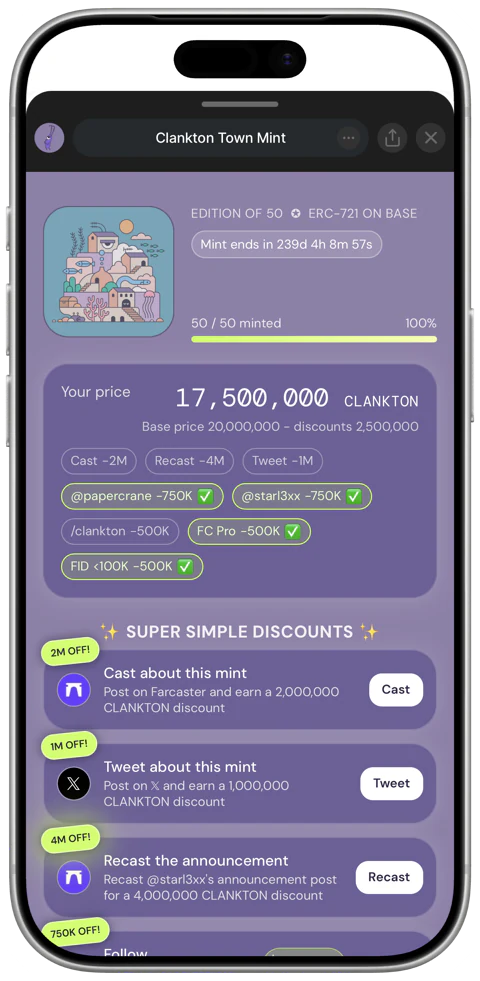
A 50-edition NFT by thepapercrane, minted on Base in $CLANKTON, the token that later migrated to $WORD. Talking about the mint was what made it cheaper, and all fifty sold.
By the numbers
50 / 50editions minted
40collectors
3d 15hopen to sold out
45%average discount earned
451M$CLANKTON discounted
nonemints at full price
Minting opened 16 December 2025 at 17:00 UTC and closed sold out on 20 December. Read back from the contract’s mint events on Base.
What it does
- Sharing set the price
- The list price was 20,000,000 $CLANKTON (about $10 when it was announced, with the floor landing near $5). Eight social actions each knocked a fixed amount off: a cast was worth 2M, recasting the announcement 4M, a tweet 1M, and follows, channel membership, Farcaster Pro and an early-FID check between 500K and 750K apiece, down to a floor of 10,000,000.
- Discounts you can’t grant yourself
- Every claim is verified against Neynar server-side and the final price is signed, then checked again by the contract. The browser can ask for a discount; it can’t award one.
- A mini app, not a mint page
- Running inside Farcaster means it already knows who you are, so five of the eight discounts resolve the moment it opens and the rest compose in place.
How it works
- Open it in a Farcaster client and it reads your FID, then settles the five automatic discounts on the spot: the two follows, /clankton membership, Farcaster Pro, and whether your FID is under 100,000.
- The other three are things you do: cast, recast the announcement, or tweet. Each opens a composer, and the discount only lands once Neynar confirms the post, written to Postgres against your wallet, idempotently, so it can’t be claimed twice.
- At mint the server recomputes your price from the database and signs it as an EIP-712 message. The contract verifies that signature before it will accept payment, so the discount is enforced onchain rather than in the interface.
- Signatures are single-use and the edition is capped at 50 in the contract, so neither the price nor the supply depends on the app behaving itself.