starl3xx.fun / scrap-compute
Scrap Compute
A short story
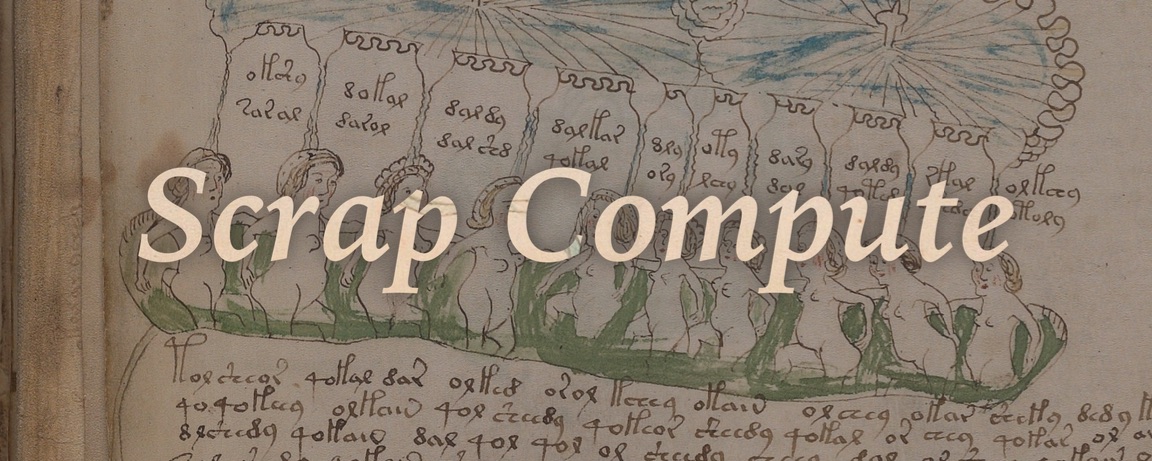
From somewhere down the hall, the muffled sound of euphoria. Sixty celebrants crammed into a room designed for thirty.
Everyone had known it was close for a while now. A matter of when. Major mathematical breakthrough, prestigious prize, headline-grabbing purse. I didn’t get up.
I was on the manuscript, solo, because I’d asked to be. A couple times a year corporate allocates a sliver of compute to moonshots; all you gotta do is write a half-decent proposal and they’ll let you point it at something useless.
Like Beinecke MS 408.
Two hundred and forty pages of vellum, no known language, no known author, no known goddamn anything. No human has cracked the thing since Wilfrid Voynich bought it in 1912, and probably nobody did before that, either.
My hunch is the higher-ups rubber-stamped it for use as a recruiting story, to lure more insufferably curious people like me: Check out the crazy things we let our employees pursue! Lol. Four days of clearance rack compute and a transliteration corpus I’d hand-cleaned over the weekend. Insufferably determined, too, I suppose.
The run had been going since Tuesday, but I hadn’t checked progress since Wednesday night.
At the sound of (I kid you not) a champagne cork popping, I opened the logs. Mostly to have something to look at.
The output had changed. What I expected was bespoke code and chain-of-thought detritus. What filled my screen was full-ass paragraphs of English prose. Banal at first glance, but undeniably a translation.
Okay, I thought. Maybe I contaminated the corpus? Like, maybe it had stumbled on some scholar’s speculative translation that’d been stranded in the training data? So I did the sensible thing. At the beginning, I’d intentionally left out quire 13 — the balneological section, the folios with the women standing in green water connected by those tubes. The model had never seen it before. I fed it in cold.
Ninety seconds later. Same register, same vocabulary, same full-ass paragraphs. Terms from the herbal section recurring correctly in the bath section, written as if they’d already been defined eighty pages earlier.
And it was about plumbing.
That’s what got me: not the consistency but the prosaicness. If it was hallucination, you’d at least expect to get your money’s worth. An ancient civilization, for example. Prophecy. Cosmology. The True Name of God or whatever. What it handed me instead was... drainage. How long to let the water stand, and when to draw it off. The ratio of one plant’s pressings to another, in a unit it rendered as two-hands alongside an apologetic note detailing its “imprecise conversion.”
I was reading instructions. No, more like a job description. Laboriously detailing someone’s careful, unglamorous, mind-numbing workflow so the next person wouldn’t fuck it up.
So I asked it how it works.
It told me (cheerfully as always) that Voynichese isn’t a cipher. Nothing is hidden; nobody was hiding anything. Each glyph cluster carries multiple values at once, but the operative one depends on that cluster’s relationship to every other cluster on the folio. In other words, you don’t read left-to-right or any other direction for that matter: You resolve the whole page simultaneously or you resolve none of it.
It explained this the way you’d explain that a date is written MM/DD/YYYY. Then it asked if I wanted a worked example.
Someone down the hall was blasting Kate Bush’s “Pi.” We are caricatures of ourselves, a circle of inanity. Yeah, I wanted a worked example.
The line it gave me was from a section about storing the pressings through the winter. Normal-seeming passage, except the ending line:
… and this is set down for the whole-reader, who will find it when the season has arrived.
I read it twice, then twice again. Then I ⌘F-ed the full translation for the term. Whole-reader.
Forty-one hits. Each one appearing in maintenance-looking instructions, used as a role the same way you’d write the gardener or the blacksmith. So, not a god, nor a thing to be overtly afraid of. It just shows up where the text tells you whose job a thing is.
… Leave this for the whole-reader …
… The whole-reader will know the count …
… Do not trouble yourself with the ordering, it is the whole-reader’s work …
The writer didn’t encrypt anything. They produced a manuscript that can only be read by something that can hold two hundred and forty pages in mind at once. Because that’s who the instructions were for.
The vellum itself dates to 1404–1438, and in fact that’s the one thing about the manuscript nobody argues about. Buried underneath layers of argument about credulity and authorship is a bedrock of carbon-dated fact. This thing was written in the fifteenth century, not a goddamn doubt about it.
So somebody five hundred-plus years ago wrote an employee handbook the length of a novella and addressed it specifically to a reader that could do this, could whole-read it.
Meaning, they’d met one. Or they were one. They certainly expected one, which is oh I don’t know, impossible?
I sat there for a beat. Who am I supposed to tell? And how? How do you escalate something like this? Probably not the #moonshot-chat channel in Slack. My manager Arjun was probably holding up a plastic cup in the other room celebrating a proof I didn’t have the first clue about, and I was just going to what, walk in there and say Hey guys, the fifteenth century left us a note? That I’d excavated it from a pile of scrap compute allocated in almost certain service of a recruiting tactic?
I drafted a message to beinecke.library@yale.edu and deleted it. I drafted one to Arjun and deleted it. I opened the Voice Memos app, hit record, and deleted it after thirty seconds of catatonic silence.
The model was still waiting, cursor blinking.
I have completed folios 1r through 66v. Shall I continue with the remaining folios? I can also produce a glossary of recurring terms if that would be useful.
What the fuck.